
Arrest Warrants in Copiah County
Every Copiah County warrant begins with words sworn on paper. Someone signs an affidavit laying out an offense. A judge then weighs probable cause. Rule 3.1 of the Mississippi Rules of Criminal Procedure directs that judge to issue an arrest warrant or, when the rule allows, a summons in its place. The summons route is common in Copiah County, not rare. It fits when the person is not already in custody, the offense is bailable as of right, and nothing suggests the paper will be ignored. One judgment call separates the two outcomes. A summons shows up like any other mail. A warrant brings a deputy to the door with authority to arrest.
Who Files a Copiah County Warrant Affidavit
The county's justice court page names the agencies that bring criminal affidavits to its counter in Copiah County. The list runs longer than most people expect for a rural county.
- Private citizens, who may swear out an affidavit in their own name
- Mississippi Highway Patrol and Copiah County Sheriff's deputies
- Mississippi Department of Wildlife, Fisheries and Parks, and the Department of Transportation
- Campus police at Copiah-Lincoln Community College and the Hinds Community College Utica campus
- Mississippi Bureau of Narcotics agents, and constables Jimmy D. White and Chris Granger
County Prosecuting Attorney Elise Munn carries the state's side of Copiah County justice court cases. That name matters. It is often the fastest way for a Copiah County clerk to find the right file, so learn which agency signed your affidavit before you call.
What a Copiah County Arrest Warrant Contains
Rule 3.2 spells out what a warrant must contain. The rule reads the same in a Hazlehurst courtroom as anywhere else in the state. Copiah County posts no sample warrant for public viewing. The field list below comes straight from the rule itself, not from a local record.
| Judge's signature | Without it the document is not a warrant at all |
|---|---|
| Name or description | The complete name, or a description certain enough to identify the person |
| Known location | Included when the court has it, to help the serving officer |
| Offense charged | The allegation the affidavit supported |
| Command | An order to arrest and bring the person before the issuing or nearest available judge |
| Release direction | Recognizance, appearance bond, or secured bond where bail is allowed as of right |
Note: A fully executed Copiah County warrant also shows the issue date, the execution status, and the clerk the document returns to.
From Copiah County Affidavit to Bond Hearing
A Copiah County felony affidavit moves in stages. It never jumps straight to circuit court, and each stage has a different office answering the phone.
- The affidavit is filed at Copiah County justice court and a judge reviews it for probable cause.
- An arrest warrant or summons issues, and an authorized officer serves it.
- Justice court holds an initial appearance and sets bond on the felony affidavit.
- A defendant who remains unbonded may request a preliminary hearing through counsel, where the judge tests probable cause and decides on bind-over.
- A grand jury indictment moves the file to the circuit clerk, and a capias may issue from there.
How Copiah County Arrest Warrants Are Served
Any officer authorized under Mississippi law may execute a warrant anywhere in the state. Execution means an arrest. Afterward the officer writes the manner and date of execution on the document, signs it, states a badge number, and promptly returns it to the clerk the warrant names. Service in Copiah County is often a joint effort. In January 2025 local reporting described Crystal Springs police officers and Copiah County deputies executing an arrest warrant together in a serious felony investigation. That is the normal shape of a significant case. Sheriff Byron Swilley's office can say whether deputies hold process for service. Call (601) 892-2023 or (601) 894-3011. A deputy's answer is a pointer. The docket is the record. Note: Copiah County deputies can say whether process is out for service, and only the clerk's docket shows what the court entered.
No Copiah County Arrest Warrant Roster
The Copiah County sheriff's site posts no arrest warrant search, no downloadable list, and no warrant division page. None of the five municipalities publishes one either. That gap should shape how you search. It does not mean nothing exists. The record sits on paper inside a court system rather than on a public web page, so the honest route runs through the clerk. Ask the issuing court directly. Any site claiming to publish Copiah County arrest warrants is not drawing on an official county source. Treat those listings accordingly.
Arrest Warrant vs Summons vs Bench Warrant
Three papers, three different moments in a case. Mistaking one for another is how people call the wrong Copiah County office for a week.
| Point | Arrest Warrant | Summons | Bench Warrant |
|---|---|---|---|
| Starts with | Probable cause on an affidavit | A charge filed without custody | A missed court obligation |
| What it orders | Arrest and appearance | Appearance on a date | Custody to force appearance |
| Who signs | The reviewing judge | The court taking the charge | The judge on the open case |
| If ignored | Officers may act on it | It can become a warrant | It stays live until recalled |
The Copiah County bench warrant page covers that third column. Each paper looks much like the others. Note: Read the heading on your Copiah County paperwork first, because the three documents route to different offices.
A Copiah County Warrant Is Not a Conviction
Here the confusion causes real harm in Copiah County. A warrant shows one thing plainly: a judge found reason to believe an offense occurred and ordered the person brought to court. That starts a process. It ends nothing by itself. The arrest settles no charge either. What settles a charge is the final entry on the docket. That entry may read dismissed, dropped by the state, acquitted, or something else entirely. So when you read a charge line, ask the clerk for the docket entry that shows how the case finished, since that line is the record worth relying on.
Key point: A charge line describes an allegation. Only the final docket entry from the court tells you what happened to the case.
What to Do If There's a Warrant for You
You still get to pick the time and place. Acting early in Copiah County keeps the choices yours. The routes are the standard three. You can appear on your own before the issuing court, post bond where the warrant allows it, or have a lawyer ask the judge to recall or quash it. The Gallman jail publishes no walk-in surrender procedure, intake schedule, or bond window. Call ahead and ask what to bring.
Important: Speak with a lawyer before surrendering on a felony matter, because bond, timing, and what you say at intake all carry consequences.
The county warrant overview lays out the same Copiah County options with bond and recall detail in one place.
Federal Arrest Warrants Leave Copiah County
A federal warrant never becomes a Copiah County case. Calling the sheriff about one just burns time. The county belongs to the Southern District of Mississippi, whose court offices operate from Jackson, Hattiesburg, Gulfport, and Natchez.
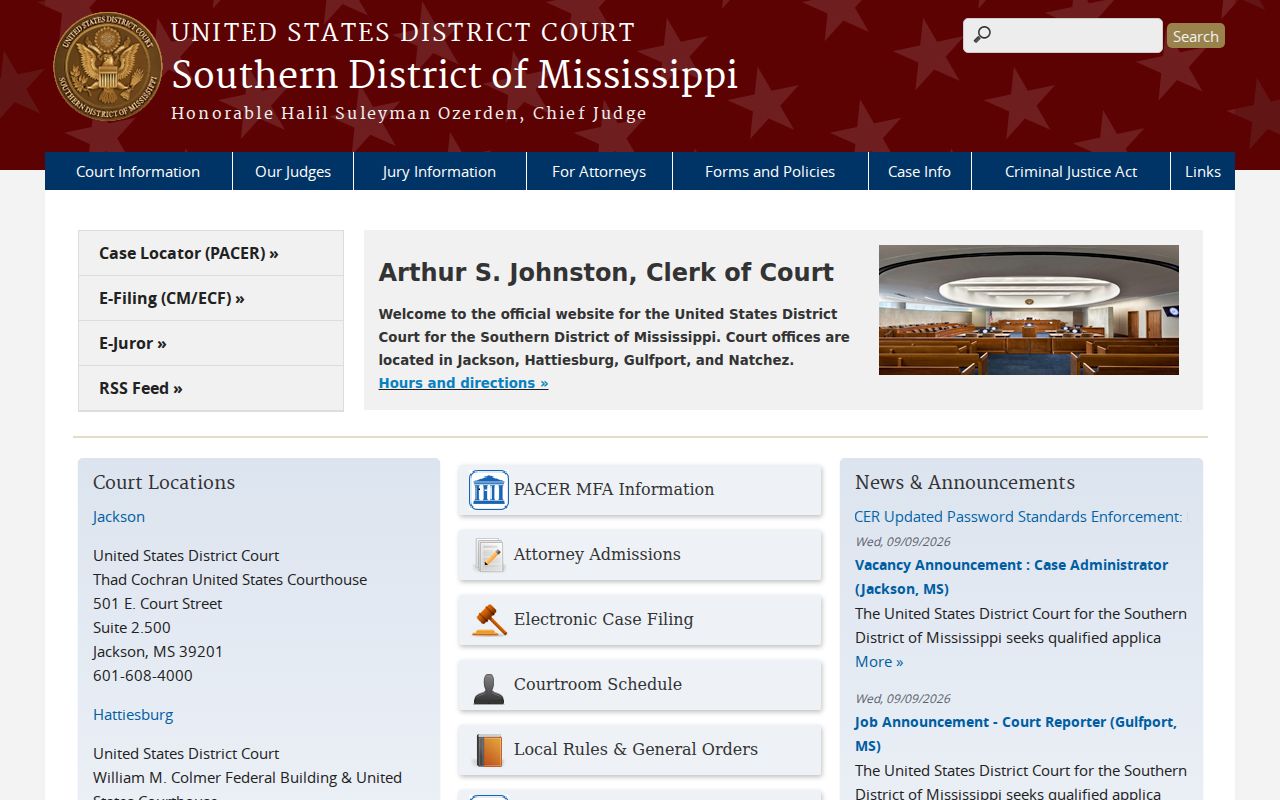
The district court site lists the Jackson courthouse at 501 E. Court Street, Suite 2.500. Its number is (601) 608-4000. For docket research, the site points to PACER. PACER charges under its own published terms. Questions about service or fugitives go to the U.S. Marshals in Suite 1.150 of the same building, at (601) 608-6800. Note: Federal bond and appearance rules are a separate system, so never pay a Copiah County clerk toward a federal case.