
Bench Warrants in Copiah County
The name is literal. A Copiah County judge sitting on the bench orders that a person be brought in, almost always because a required appearance never happened. An unpaid fine can trigger it. So can a broken condition of release or a ignored court direction. What a Copiah County bench warrant is not, though, is a new charge. The underlying case stays exactly what it was before the judge signed. The warrant is simply the court's tool for pulling the person back into the room so the matter can move again, which is why the fix nearly always involves showing up rather than rearguing the case itself. The Copiah County warrant overview lays out the resolving options in one place.
The Copiah County Bench Warrant Flags
Copiah County sits inside the Fifteenth Chancery District, which runs on the state electronic court system. The district publishes a plain-English key to the docket status codes. Two of those entries are the closest official language Copiah County has for a bench warrant.
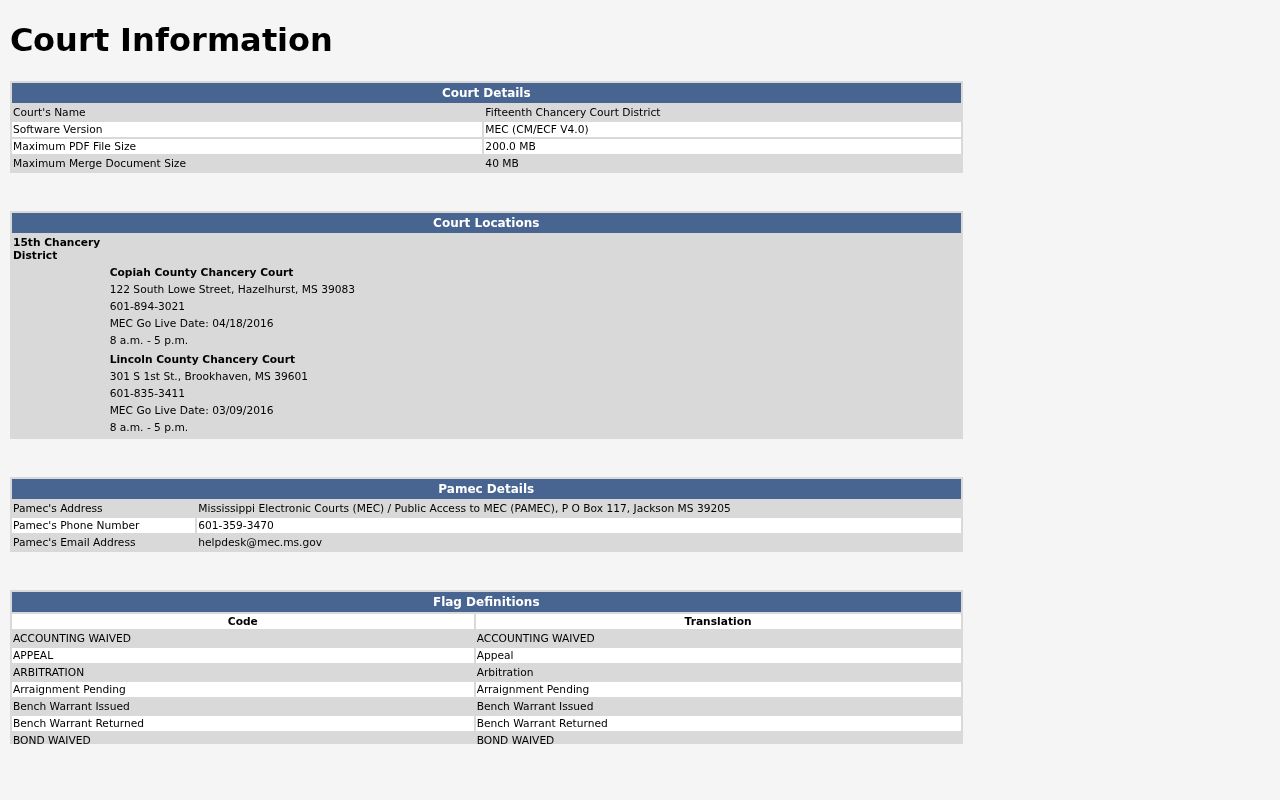
The published translations include Bench Warrant Issued and Bench Warrant Returned, sitting beside arraignment, bond, and appeal flags. The same court information page lists Copiah office hours of 8 a.m. to 5 p.m. and dates the county's move onto the electronic system to April 2016. Read the flags carefully. Issued means the judge signed an order. Returned means an officer handed the paper back to the clerk with a note on what was done. Neither one says the case ended.
How a Bench Warrant Is Issued
A Copiah County judge does it on the record, with no new investigation behind it. Nobody swears out a fresh affidavit, and no deputy asks permission. The setting passes, the chair stays empty, and the court enters an order for custody.
- A scheduled appearance is missed and nobody appears for the defendant.
- A fine or a payment arrangement falls behind past what the court allowed.
- A condition the judge attached to release is broken.
- A person summonsed on a charge never answers the summons.
Note: Contempt is a separate power under Rule 32, so one missed setting can bring both a Copiah County warrant and a contempt question into the same hearing.
From Summons to Copiah County Warrant
Mississippi builds a staircase rather than a cliff. Rule 3.1 lets a judge start with a summons instead of an arrest warrant when three things line up: the person is not in custody, the offense is bailable as of right, and nothing suggests the person will skip. From there the rule names three ways a summons turns into a warrant. The person fails to appear. There is reasonable cause to believe the person will not appear. Or the summons simply cannot be served. The sequence in a Copiah County file reads plainly enough: charge filed, summons issued, appearance missed, warrant signed, officer serves or returns it, and the court acts.
Bench Warrant vs Arrest Warrant
Both kinds of warrant end with a person in custody, and that shared ending hides very different beginnings. The table below sets them side by side as they work in Copiah County courts. The start of each tells the real story.
| Point of Comparison | Bench Warrant | Arrest Warrant |
|---|---|---|
| What triggers it | A missed setting or broken court obligation | A probable cause finding on a charging affidavit |
| Who starts it | The judge, on the court's own record | An officer, citizen, or agency filing an affidavit |
| Relation to the case | Attached to a case already open | Opens the criminal case against the person |
| Usual first fix | Appear, pay, or move to recall | Bond, counsel, and an initial appearance |
| Where the file sits | With the judge who set the date | With the court that took the affidavit |
Note: Either kind of warrant can put a Copiah County resident in custody, so the practical difference is which clerk holds the file.
A Copiah County Capias After Indictment
Capias is a word that shows up on Copiah County circuit paper and puzzles people who expect it to mean a traffic penalty. Rule 1.4 of the Mississippi Rules of Criminal Procedure defines it as a writ commanding law enforcement to take custody of a defendant a grand jury has indicted. That is narrower than a bench warrant. A capias follows an indictment. A Copiah County bench warrant follows a missed obligation. Local paperwork does not always keep the labels clean, so ask the clerk which document the docket reflects and what the court expects next. Once an indictment exists, the file belongs to Circuit Clerk Derrick Cubit at 100 Caldwell Dr. in Hazlehurst, reachable on (601) 894-1241. Note: Ask the Copiah County clerk which label the docket uses, since paperwork does not always separate a capias from a bench warrant.
How to Resolve a Copiah County Bench Warrant
Resolving one is a court transaction, and the shape holds in every Copiah County courtroom. The clerk sets it up, the judge decides it, and paper proves it happened.
- Call the issuing clerk and ask for the docket status and the reason the warrant entered.
- Ask exactly what the judge will accept: an appearance on a set date, a payment, a reset, or a motion.
- Ask whether counsel is required or simply advisable for your kind of case.
- Do the thing the court named, and do it in the way the court named.
- Collect written confirmation that the warrant was recalled or returned.
No expiration: Mississippi sets no expiration date for a bench warrant, so never assume an old Copiah County warrant lapsed on its own. Ask the issuing court whether it is still in force.
Missed Settings and Copiah County Warrants
Missed your day in Copiah County court? Move the next morning, not next month. The sooner the court hears from you, the more options it has. Call the clerk listed on the paperwork first. Explain what happened in one plain sentence. Then ask for the earliest available setting. The Copiah County justice court follows a published rhythm that helps here. Preliminary hearings land on the second Monday of each month. Contested misdemeanor hearings fall on a monthly Thursday, and civil matters come up twice monthly on Wednesdays. Those settings move, so confirm the date with Justice Court Clerk Mona Carr at (601) 894-3218 instead of trusting the pattern. If a lawyer already represents you, that office should place the call.
Which Copiah County Court Issued It
Look at the paperwork first. Copiah County gives you four possible courts, and the document usually names its own. Justice court, under Judges Teresa G. Bozeman and Price D. Henley, handles misdemeanor and traffic cases. Circuit court, with Judge Tomika H. Irving, takes indicted felonies. A municipal court keeps its own city cases. Chancery court, under Judge Joseph Durr, covers youth, commitment, and family matters, and those files carry their own access limits. No court here offers a public Copiah County bench warrant name search. So routing comes first. The lookup question waits until you know which bench signed the process. Note: Ask which court issued it before asking whether the sheriff holds it, because the issuing court controls both the record and the remedy.
Returned Copiah County Warrants Are Not Cleared
A returned flag on a Copiah County docket looks like progress. Often it is not. Return is just a filing event, meaning the officer handed the process back to the clerk, noted how it was executed, and signed off. That says nothing about the case ending. A new court date may still be waiting, and any license hold may still stand. Treat a Copiah County phone call with the same caution. A deputy saying nothing came up is not a judge recalling the warrant. A paid receipt is not that either. Ask the clerk for the order and read the word recalled or quashed on it. Only that language finishes a Copiah County warrant matter.